
Guide · Marine & RV
Marine sanitation hose: stopping holding-tank odour and choosing replacement hose
If a boat smells below deck and the tank is not leaking, the hose is. Ordinary PVC hose lets odour molecules migrate through the wall over a season or two. Here is how to confirm it, what to replace it with and how to route the new run so the problem does not come back.
The rag test
Wet a clean rag with hot water, wrap it tightly around a section of the hose for a minute, then smell the rag. If it smells like the holding tank, the hose wall has permeated and no amount of cleaning will fix it. Check the runs from the head to the tank, the tank vent line and the deck pump-out line separately; the first two are the usual offenders.
Why hose permeates
Sewage gases dissolve into flexible PVC and diffuse outward. Thin-wall or general-purpose hose permeates within a season; sanitation-grade hose uses a thicker, denser wall formulated to resist it, and lasts many times longer. Hose that runs uphill or sags so waste sits in it permeates fastest, because it is wet inside all the time.
Choosing replacement hose
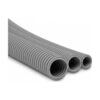
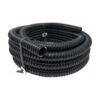
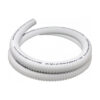
Use a hose made for sanitation. Rollerflex marine hose offers two: the 148 series, a smooth-bore heavy-wall sanitation hose that is easiest to keep clean and pass through bulkheads, and the 140 series, a corrugated sanitation hose that bends tighter for cramped runs. Both are made in Elizabeth, NJ from compounds selected to resist permeation.
Sizes
Marine heads and holding tanks use 1-1/2″ I.D. for the discharge line and typically 3/4″ or 1″ for the tank vent. Measure the fittings; do not assume. Buy cut lengths a little longer than you need and trim on the boat.
Routing rules
- Run downhill from head to tank wherever possible so the hose drains empty.
- Keep bends gentle; use the corrugated series where a tight bend is unavoidable rather than kinking smooth hose.
- Support the hose every 18 inches or so and keep it off hot engine parts.
- Install a vented loop where the head is below the waterline, per the toilet manufacturer.
- Double-clamp every connection with stainless clamps, screws opposed.
Working with old hose
Permeated hose is stiff and will not slide off a fitting. Cut it lengthwise with a knife rather than fighting it, and wear gloves. Warm the new hose ends in hot water to ease them onto barbs; a little dish soap helps. Do not use petroleum grease on PVC.
Bilge, livewell and vac hose are different
Bilge and livewell pumps need a hose that holds vacuum on the intake and pressure on the discharge and tolerates constant flexing as the hull works: the heavy-duty 145 and 149 series. The light-duty 141 vac hose suits deck wash-down and vacuum systems. None of these should be used for sanitation, and sanitation hose should not be used for fuel — fuel lines must be USCG-rated.
RV drain hose
Recreational vehicles have their own standard: 3″ spiral-reinforced RV drain hose, IAPMO R&T Listed (T-3334), which compresses for storage and connects with bayonet fittings at the outlet and the dump station.
Need a part number or a quote? Our sales team in Elizabeth, NJ will come back to you with availability and pricing.