
Guide · Industrial hose
Suction hose vs. discharge hose: choosing PVC hose for pumps
Pump hose fails for predictable reasons: the wrong side of the pump, the wrong size, or the wrong temperature. This guide covers what makes a suction hose different from a discharge hose and how to read the ratings on a Rollerflex family page.
The difference
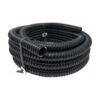
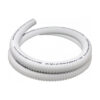
On the suction side the pump pulls a vacuum inside the hose; atmospheric pressure outside tries to crush it. A suction hose needs a rigid PVC helix (the spiral rib) to hold the bore open — without it the hose flattens and the pump starves or loses prime. On the discharge side the hose is pressurised from inside and only needs enough wall and reinforcement to hold the working pressure; it can be lighter and lay flat when empty. Spiral-reinforced Rollerflex hose handles both duties, which is why one hose is often run on both sides of a portable pump.
Sizing
Start with the pump’s port sizes: suction hose I.D. should be at least the size of the suction port, never smaller. Undersized suction hose is the most common cause of cavitation and poor flow. Discharge hose can be one size smaller than the port if head loss is acceptable, but longer runs argue for the full size. Rollerflex water suction and discharge hose runs from 3/4″ to 4″ I.D. in standard construction, with larger sizes on request.
Reading the ratings
Rating |
What it means |
What to check |
|---|---|---|
Working pressure (psi @ 70°F) |
Maximum continuous pressure at room temperature |
Pump discharge pressure including head; derate at higher temperature |
Vacuum (in. Hg) |
Suction the hose withstands without collapsing |
Most centrifugal and trash pumps need 20–28 in. Hg |
Bend radius |
Tightest bend without kinking |
Route around equipment, avoid bending at the fitting |
Temperature range |
Fluid and ambient limits |
Hot wash-down, cold-weather flexibility (see TX series) |
Every Rollerflex family page lists working pressure and vacuum per size at 70°F. PVC softens as it warms: at 120°F expect substantially lower pressure capacity than at 70°F.
Which Rollerflex series
- 1000 CL / 1000 GR — clear or green general-purpose water suction and discharge; the clear wall shows flow and debris.
- DH — heavy-wall discharge for higher pressure and abrasion.
- TX — low-temperature compound that stays flexible in freezing weather for winter dewatering and cold rooms.
- 5000 — air and dust vacuum, not for liquids under pressure.
- 4000 / 9000 — FDA-compliant food, beverage and dairy transfer.
- 6000 LT / 7000 — bulk material handling, heavier wall for abrasion.
Chemical compatibility
PVC handles water, dilute acids and alkalis, many salts and most cleaning solutions. It does not handle aromatic solvents, ketones or hot oils. Check the fluid against our chemical resistance chart, and specify the food-grade series where the product will be consumed.
Fittings
Use barbed or king-nipple fittings sized to the hose I.D., secured with double band clamps or a preformed clamp on the suction side, where a small leak means lost prime. Camlock adapters make quick changes on the larger sizes. Do not use the hose to support the fitting’s weight — clamp or hang the fitting end.
Making it last
- Drain and coil loosely after use; store out of direct sun.
- Do not drive over hose; the helix resists crushing but not a truck.
- Replace hose that has whitened, stiffened or shows helix separation.
Need a part number or a quote? Our sales team in Elizabeth, NJ will come back to you with availability and pricing.