
Guide · Conduit & connectors
ENT (smurf tube): where it is permitted, where it is not, and how to install it
Electrical nonmetallic tubing — the blue corrugated raceway everyone calls smurf tube — is fast to run and forgiving to bend, which is why it is everywhere in residential and light commercial work. Its rules in NEC Article 362 are short, but a few of them catch people out.
What ENT is
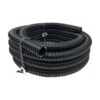
ENT is a pliable, corrugated, non-metallic raceway of circular cross section, made from a flame-retardant PVC compound and listed to UL 1653. It bends by hand, is cut with a knife or PVC cutter, and joins to boxes and couplings with listed snap-in or threaded fittings — no cement. Sealproof ENT is made in Elizabeth, NJ in 1/2″ through 2″ trade sizes, in coils, reels and 10-foot sticks.
Permitted uses (362.10)
- Concealed in walls, floors and ceilings of any building — subject to the conditions below.
- Exposed, where not subject to physical damage, in buildings not exceeding three floors above grade.
- Above suspended ceilings where the ceiling has a 15-minute finish rating (or per the exception).
- In poured concrete — slabs, walls and columns — with listed fittings. This is one of ENT’s main advantages over EMT.
- Wet locations indoors (car washes, dairies) where listed for the purpose and with listed fittings.
- Direct burial where listed and marked.
Not permitted (362.12)
- In hazardous (classified) locations except as specifically permitted.
- For the support of luminaires or other equipment.
- Where ambient temperature exceeds 122°F (50°C) unless listed otherwise.
- For conductors whose insulation temperature limit exceeds the tubing’s rating.
- For circuits over 600 volts nominal.
- In places of assembly and theatres, except as permitted in Articles 518 and 520.
- Exposed, where subject to physical damage.
- Where exposed to direct sunlight unless listed as sunlight-resistant.
Installation
Sizes and fill
Trade sizes 1/2″ through 2″ (362.20). Conductor fill follows Chapter 9, Table 1 (40% for three or more conductors) using the ENT internal areas in Table 4.
Bends
Make bends by hand so the tubing is not damaged and the internal diameter is not reduced. No more than 360° of bends between pull points (362.26).
Support (362.30)
Secure ENT within 3 feet of every box, cabinet or termination and at intervals not exceeding 3 feet. Horizontal runs through framing members with openings up to 3 feet apart count as supported. Lengths of up to 6 feet from a fixture whip termination need not be secured.
Fittings and boxes
Use only fittings listed for ENT (362.46). Snap-in connectors and couplings are the norm; threaded adapters are available for boxes with threaded hubs. ENT is non-metallic, so run an equipment grounding conductor.
Concrete
Tie ENT to the reinforcing steel before the pour, keep stub-ups plumb and capped, and use couplings listed for concrete encasement. Sealproof ENT couplings are available in each trade size.
ENT vs. other flexible raceways
ENT |
LFNC-B |
Flexible electrical tubing |
|
|---|---|---|---|
Listing |
UL 1653 raceway |
UL 1660 raceway |
Not a listed raceway |
Outdoors / wet |
Only where listed |
Yes, sunlight and wet-location rated |
Protective sleeving only |
Concrete |
Yes |
Where listed |
No |
Typical use |
Branch circuits in walls and slabs |
Equipment connections, outdoors |
Low-voltage protection |
Need a part number or a quote? Our sales team in Elizabeth, NJ will come back to you with availability and pricing.