
Guide · Conduit & connectors
LFNC-A, LFNC-B and LFNC-C: which liquid-tight non-metallic conduit to use
Liquid-tight flexible non-metallic conduit comes in three constructions, and the letter on the jacket matters for what you can do with it. This guide explains the differences, the permitted uses under NEC Article 356, and how to size and terminate the most common type, LFNC-B.
The three constructions
Type |
Construction |
Typical name |
|---|---|---|
LFNC-A |
Smooth seamless outer jacket over a separate corrugated inner core, with reinforcement between the layers |
“Type A” |
LFNC-B |
Smooth seamless inner core and jacket bonded together with reinforcement embedded in the wall |
“Type B”, NMLT, “gray liquid-tight” |
LFNC-C |
Corrugated outer and inner surfaces, no integral reinforcement |
“Type C”, corrugated liquid-tight |
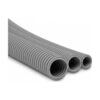
LFNC-B is by far the most common in North America. Its smooth bore makes pulling conductors easy, the integral reinforcement keeps it round in bends, and the jacket compound is rated for sunlight and wet locations. Sealproof non-metallic liquid-tight conduit is LFNC-B, made in Elizabeth, NJ and cULus Listed to UL 1660.
Where LFNC is permitted (356.10)
- Exposed or concealed, where flexibility is needed for installation, operation or maintenance — condensers, pumps, motors, machine tools.
- Where protection from liquids, vapours or solids is required.
- Outdoors and in wet locations when listed and marked for the purpose.
- Direct burial, when listed and marked for direct burial.
- In lengths over 6 feet where secured per 356.30 and the conduit is listed for it, or as a fixture whip.
- Encased in concrete where listed for that use, and LFNC-B in lengths of any size in industrial installations with qualified maintenance.
Where it is not permitted (356.12)
- Where subject to physical damage.
- Where the combination of ambient and conductor temperature exceeds the conduit’s rating.
- In lengths over 6 feet except as allowed above.
- Where voltage exceeds 600 volts nominal, except as permitted for luminaires.
- In hazardous (classified) locations except as specifically permitted.
Bends and support
Bends between pull points must not total more than 360° (356.26). Secure LFNC within 12 inches of every box, fitting or termination and at intervals not exceeding 3 feet (356.30), with the usual exceptions for fixture whips and lengths up to 3 feet at equipment that needs flexibility.
Fittings
Only fittings listed for LFNC may be used, and they must match the conduit type — a fitting listed for LFNC-B is not automatically suitable for LFNC-A. Sealproof offers two families for LFNC-B:
- Nylon (non-metallic) connectors — corrosion-proof, the choice around pools, coastal sites and chemicals. Straight, 45° and 90°.
- Zinc die-cast connectors — where the specification calls for metallic fittings or the connection sees mechanical abuse.
Because LFNC is non-metallic it provides no equipment grounding path; run an equipment grounding conductor inside it (356.60).
Specifying
A complete specification reads, for example: “Liquid-tight flexible non-metallic conduit, Type LFNC-B, UL 1660 listed, sunlight resistant, rated for direct burial, 3/4″ trade size, gray; Sealproof or equal, with listed liquid-tight connectors.” Each Sealproof part page carries the listing file number, the markings on the jacket and a downloadable spec sheet.
Related
Need a part number or a quote? Our sales team in Elizabeth, NJ will come back to you with availability and pricing.